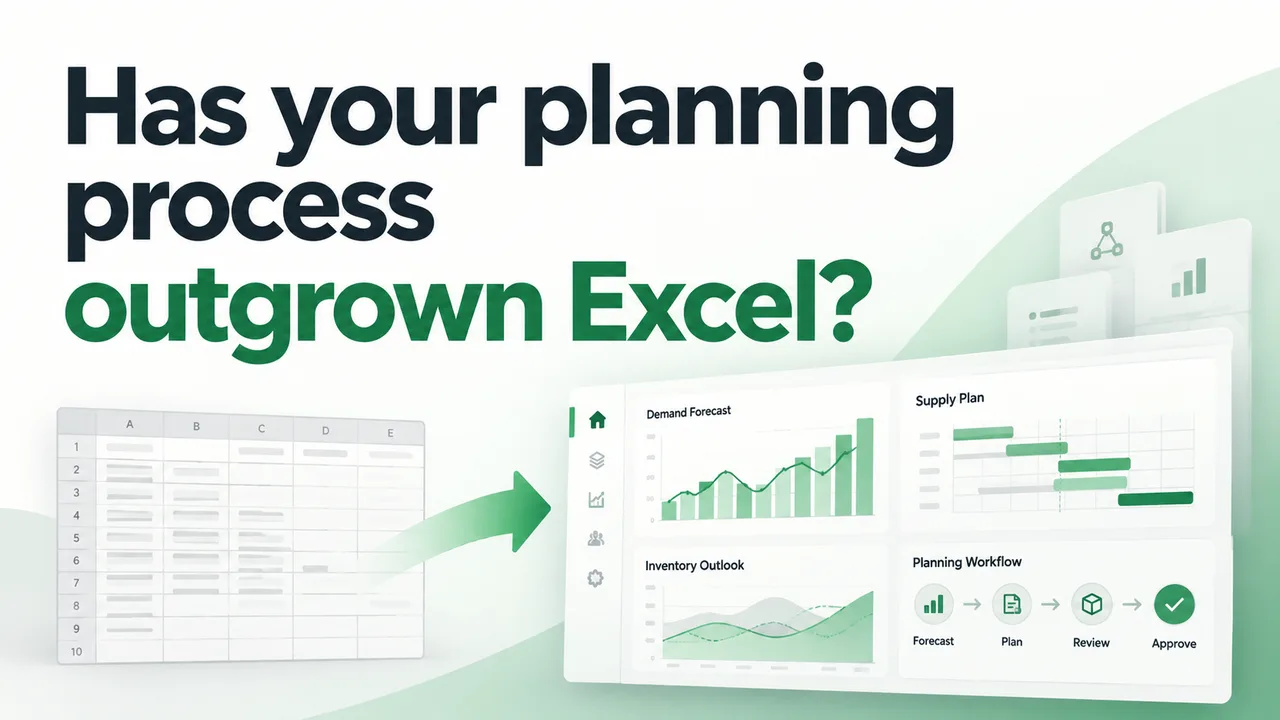
Is Your Planning Process Ready to Move Beyond Excel?
Excel is often a great place to start supply chain planning. It is flexible, familiar, and easy to build around. The question is: when has your planning process outgrown Excel?
2 min read
Research on S&OP maturity has long recognized that spreadsheets can be appropriate in earlier stages, with enabling technology becoming more relevant as the planning scope grows. At the same time, ICAEW's guidance on good spreadsheet practice recommends periodically asking whether a spreadsheet is still the appropriate tool for the job.
For a mid-market planning team, the following signs are worth watching.
A quick readiness check
Preparing the plan takes too much manual work. Data is repeatedly exported from the ERP, copied into templates, reformatted, reconciled, and consolidated before planners can begin reviewing the actual forecast.
You are managing multiple versions of the truth. Sales has one file, Supply Chain another, and Finance may have its own assumptions. Considerable effort goes into establishing which version is current before a decision can be made. ICAEW specifically highlights version control as an important control as organizations become increasingly dependent on spreadsheets.
More people need to contribute to the plan. A workbook managed by one planner is relatively easy to control. Complexity increases when several functions need to enter assumptions, review changes, or work at different product, customer, and location levels.
It is becoming difficult to understand what changed and why. Forecast overrides, assumption changes, and corrections happen throughout the planning cycle, but reconstructing who changed a number and why requires emails, meeting notes, or comparisons between files.
Planners spend too much time maintaining the process. Refreshing data, checking formulas, rebuilding reports, and preparing meeting packs take time away from investigating exceptions and making planning decisions.
The spreadsheet is becoming increasingly difficult to maintain. More formulas, tabs, macros, data connections, and dependencies make changes harder and increase reliance on the people who originally built the workbook. ICAEW recommends considering whether users can continue to understand and maintain a spreadsheet as requirements evolve.
One question to answer before buying software
Recognizing several of these symptoms is a good reason to start evaluating planning software, but the organization also needs a planning process that is clear enough to put into a system. Before making that move, the team should be able to explain who owns the forecast, which data feeds it, at what level decisions are made, how frequently the plan is reviewed, who can override it, and which metrics are used to judge performance.
That prerequisite matters because software can structure and automate an existing process, but it cannot resolve unclear ownership or an undefined way of working. McKinsey's research on supply-chain planning technology similarly emphasizes the importance of defining the future planning process and its requirements before implementing new technology.
If several of the signs above feel familiar and your planning process is already reasonably well defined, that is the point at which it becomes worth asking whether Excel should remain the primary planning environment. Excel can still play an important role in analysis and one-off calculations, while dedicated planning software takes over the recurring processes that have become difficult to manage through spreadsheets alone.
If you are unsure whether your organization has reached that point, we at Scyplan are happy to help assess your current planning process and determine whether moving beyond Excel makes sense yet.
Other relevant articles
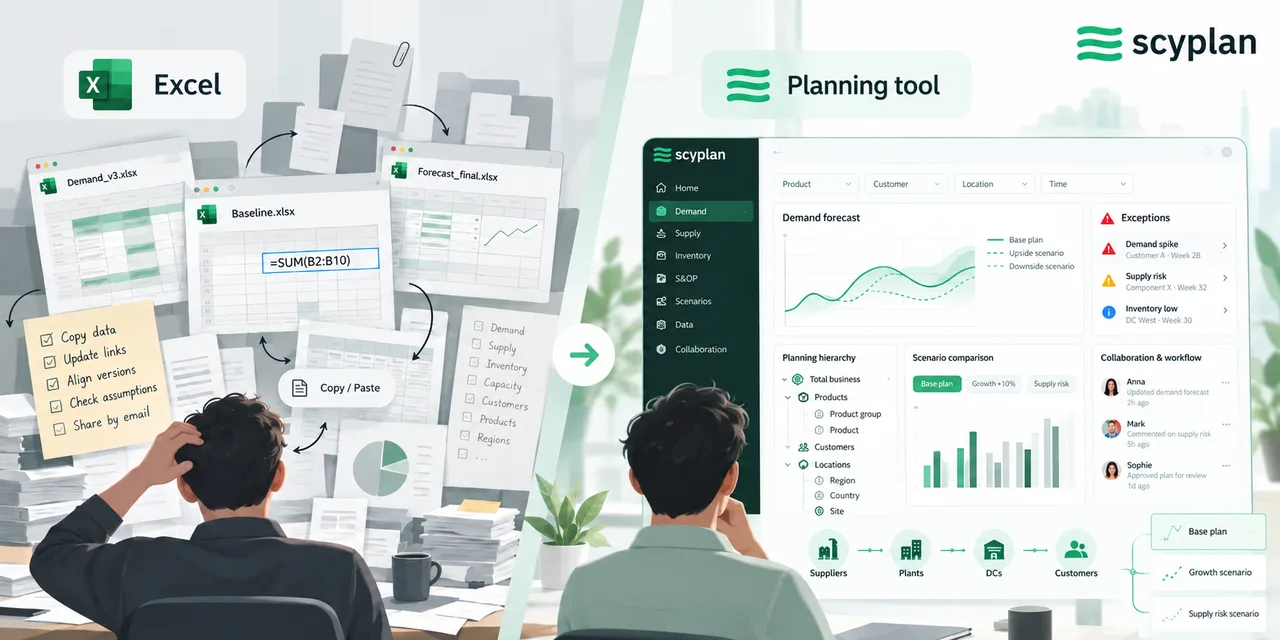
Excel vs Supply Chain Planning Software
Excel can support sophisticated supply chain planning. The real difference appears in everything around the forecast: data, workflow, collaboration, scenarios and control.
5 min read

The Worst Forecast Is Not Always Your Biggest Problem
The SKU with the worst forecast accuracy may not be your biggest planning problem. Better prioritization connects forecast exceptions with their business impact.
5 min read
How the Supply Chain Planner Role Is Changing
The planner’s role is shifting from processing information toward managing exceptions, trade-offs, and decisions. What skills and KPIs matter as planning technology improves?
4 min read