
The Worst Forecast Is Not Always Your Biggest Problem
The SKU with the worst forecast accuracy may not be your biggest planning problem. Better prioritization connects forecast exceptions with their business impact.
5 min read
Imagine a planner responsible for 10,000 SKUs reviewing the weekly forecast exceptions. One SKU sells for $0.10 per unit and has terrible forecast accuracy. Another sells for $10,000 per unit and has a forecast that looks reasonably accurate, but still misses demand by 10%. If the exception list is sorted purely by forecast accuracy, the $0.10 SKU may receive attention first even though the business consequence of the second error could be substantially larger.
This is a limitation of traditional exception management. Forecast accuracy tells planners something important about forecast quality, but it does not tell them where their limited time will create the most value. With thousands of products to manage, planning teams need to consider the financial and operational consequence of an error alongside the error itself.
Forecast accuracy does not measure business impact
The relationship between forecast accuracy and business performance is less direct than it may appear. Research published in the European Journal of Operational Research used data from the M5 forecasting competition to examine how forecast accuracy translates into inventory outcomes. The researchers found that the relationship depends on factors such as demand characteristics, inventory policies, holding costs and lost-sales costs. Under some conditions, the most accurate forecasting method did not produce the best inventory result.
Consider the two SKUs from the opening example. A 50% error on the $0.10 product looks much worse in an accuracy report than a 10% error on the $10,000 product. Yet the second error may expose substantially more revenue, margin, inventory or working capital. At the same time, price cannot determine priority on its own. The $0.10 item could be a critical component that stops a production line when unavailable, while the $10,000 product might have short lead times and flexible supply.
The relevant question is therefore broader: what is the likely business consequence if this planning issue is left unresolved?
Prioritize by consequence, not percentage error
ABC and XYZ segmentation already introduce some of this thinking. ABC segmentation can differentiate products according to volume or value, while XYZ segmentation distinguishes them according to demand predictability. SAP's guidance on ABC/XYZ segmentation describes how these dimensions can be combined to apply different planning approaches to different products.
For a portfolio of 10,000 SKUs, prioritization can go further. Depending on the business, relevant factors may include selling price, contribution margin, inventory exposure, lead time, service criticality, shelf life, obsolescence risk, availability of substitutes, premium freight and the consequences of a production disruption.
Combining those factors changes the purpose of an exception list. Instead of simply showing the 100 SKUs with the lowest forecast accuracy, it can surface the situations where an intervention has the greatest potential business impact. A 40% forecast error may fall down the list because the financial exposure is small and replenishment is easy, while an 8% error moves upward because it affects a high-value, long-lead-time product with limited alternatives.
A cost dictionary provides the common language
This kind of prioritization requires a consistent way to translate operational situations into financial terms. Supply chain may recognize an excess inventory risk or potential shortage, but comparing those situations becomes difficult when planners and finance use different assumptions about their economic impact.
An internal cost dictionary can provide that common language. Supply chain and finance should agree on how relevant consequences are valued, including inventory carrying cost, contribution margin at risk, obsolescence exposure, premium freight, lost sales and other costs that materially affect the company.
The definitions need enough precision to support consistent decisions. Inventory value, for example, does not represent the full cost of carrying inventory. APQC includes factors such as capital, storage, insurance, taxes, handling, administration, shrinkage and obsolescence in inventory carrying cost. Which components are relevant will vary by company, but the assumptions should be explicit and agreed.
A useful cost dictionary does not need to turn every forecast exception into a detailed financial business case. Its purpose is to give planning teams and their systems a consistent basis for comparing one issue with another.
Software can do the first prioritization
Once those definitions exist, a planner should not need to calculate the financial impact of hundreds of exceptions manually. Planning software can apply the agreed logic across the portfolio by combining forecast performance with inputs such as product value, margin, inventory position, lead time, service importance and relevant cost assumptions.
The output can be a prioritized queue rather than a traditional exception list. A system might identify that a relatively small forecast deviation deserves immediate attention because it affects a high-margin product with low inventory coverage and a long replenishment lead time. Another SKU with a much larger percentage error may receive a lower priority because the financial exposure is limited and supply can be adjusted easily.
AI can assist further by bringing multiple signals together, summarizing why an issue has been prioritized and suggesting the next question or action for the planner. The planner should still be able to inspect the assumptions, understand the drivers behind the recommendation and decide whether intervention is appropriate. This creates a more useful division of work: the technology performs the first screening across thousands of items, while the planner spends time on the smaller number of decisions that require judgment.
The financial estimate does not need to be perfect to improve prioritization. A consistently applied estimate can already help distinguish a statistically large forecast error with little consequence from a smaller error with significant business exposure.
The capability is also organizational
Better software does not remove the need for supply chain and finance expertise. Supply chain teams need enough financial understanding to connect inventory, service and operational decisions with working capital, cost and margin. Finance teams need enough understanding of planning mechanics to recognize why a forecast error does not translate directly into profit or loss.
This broader perspective is reflected in ASCM's SCOR performance framework, which considers customer-oriented measures such as reliability and responsiveness alongside cost, profit and asset performance. Planning decisions often involve trade-offs across these dimensions, which is why one KPI rarely provides enough information to determine priority.
A strong planning organization therefore combines forecasting knowledge, operational understanding and financial fluency. Finance helps establish the economic definitions, supply chain provides the operational context, and technology applies that logic consistently across a portfolio that would be impossible to review manually.
From exception management to value-based prioritization
With 10,000 SKUs, giving every forecast problem equal attention is neither realistic nor useful. Forecast accuracy remains an important diagnostic because it shows where forecasts perform poorly, but prioritization should continue one step further and ask what the error means for the business.
This builds on the move from analysis to action. Planning technology can help determine which actions deserve attention first by combining forecast performance with product economics, inventory exposure, service risk and operational constraints.
For planning leaders, the practical question is what currently determines the order of the exception list. When forecast accuracy remains the main filter, valuable planner time can be spent investigating statistically large problems with very small consequences. A clear cost dictionary, capable supply chain and finance teams, and software that applies their logic at scale can direct that attention toward the decisions where intervention has the greatest potential business value.
Other relevant articles

How the Supply Chain Planner Role Is Changing
The planner’s role is shifting from processing information toward managing exceptions, trade-offs, and decisions. What skills and KPIs matter as planning technology improves?
4 min read
What Is an End-to-End Planner and How Do We Get There?
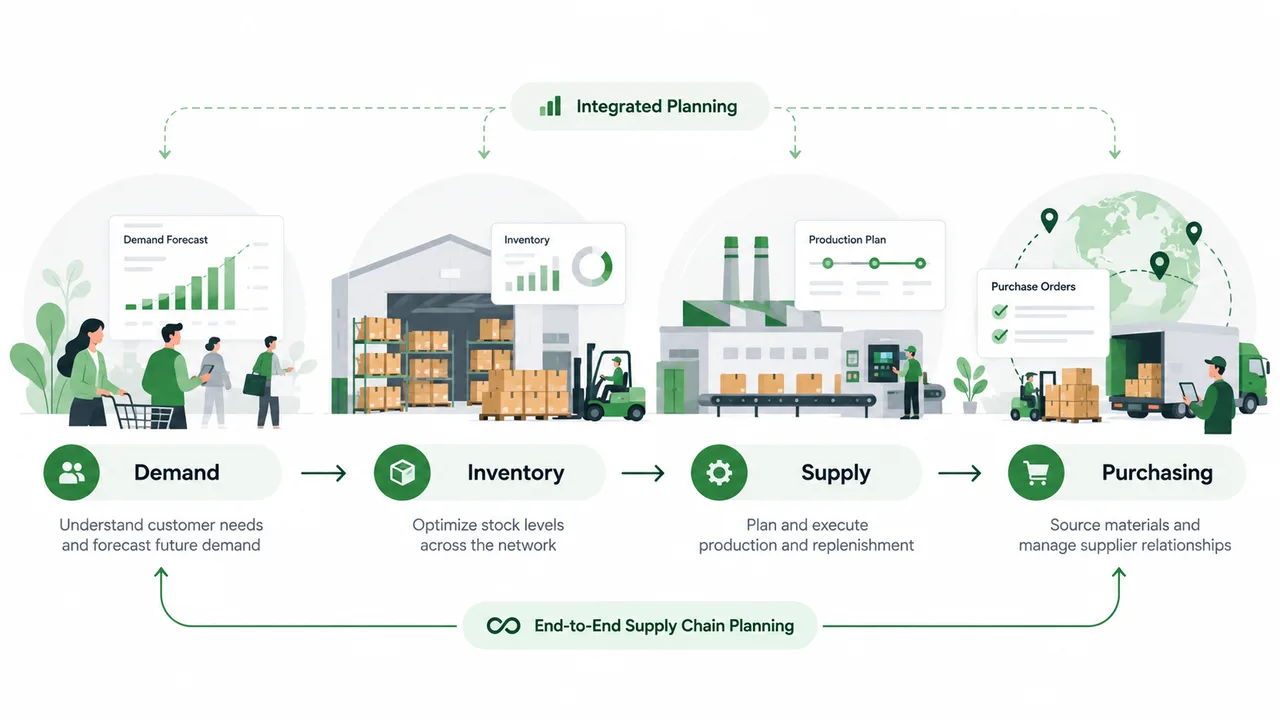
End-to-end planners connect decisions across demand, inventory, supply, production and procurement. Their rise also changes how we think about the traditional IBP cycle.
4 min read

Buy Planning Software or Vibe Code It in Excel?
AI makes it surprisingly easy to build planning tools in Excel. The harder question is whether your planning team wants to become responsible for maintaining them.
3 min read