How the Supply Chain Planner Role Is Changing
The planner’s role is shifting from processing information toward managing exceptions, trade-offs, and decisions. What skills and KPIs matter as planning technology improves?
4 min read
A planner opens the weekly review and sees a statistical forecast, commercial input, inventory risks, and a list of exceptions that need attention. Traditionally, much of the job has been working through that information: reviewing products, investigating deviations, adjusting forecasts, and preparing the numbers for the next meeting.
That work is changing. Better forecasting models, automation, and AI can increasingly handle parts of the analysis that previously consumed much of a planner’s day. The planner remains central to the process, but the value of the role is shifting toward judgment, prioritization, and decision-making.
From producing the plan to managing decisions
Planning has traditionally involved a significant amount of manual work: collecting inputs, reconciling different versions of the forecast, reviewing individual products, maintaining parameters, and investigating exceptions. Those activities remain necessary, but fewer of them need to depend entirely on the planner.
McKinsey has described a similar direction for autonomous planning, with technology handling more routine planning activities while people focus increasingly on exceptions and decisions that require business judgment.
This changes what good planning looks like. A customer promotion, product phase-out, unexpected order, capacity issue, or commercial commitment may require context that the forecasting model does not have. Instead of reviewing every SKU with the same level of attention, the planner needs to know where intervention is justified and what action should follow.
Technology can prepare the decision. The planner still needs to understand its consequences.
What makes a good planner?
A good planner understands the numbers without automatically accepting or changing them. Statistical forecasts provide an important baseline, while planners can add information about events, customers, products, and operational constraints that may not yet exist in the data.
Knowing when that judgment adds value is an important skill.
A 2022 study in the European Journal of Operational Research examined 30 million AI-generated forecasts at SKU-store-day level for a large European retailer. Planners could adjust the forecasts based on their own knowledge. The researchers found that these interventions did not improve forecast accuracy on average, with large upward adjustments particularly likely to be inaccurate.
That does not make human judgment unnecessary. It shows why intervention needs a reason. A planner who knows that a customer has confirmed a promotion is adding information. Changing a forecast simply because the number feels too low is much harder to justify.
Business outcomes also matter. A 2025 Management Science field experiment at a spare-parts retailer found that allowing merchants to adjust inputs to an inventory algorithm increased profitability by 4.92% on average compared with automation alone. The result comes from one specific retail setting, so it should not be treated as a universal benchmark. It does show that human intervention can create value when people have information relevant to the decision.
A good planner therefore needs analytical discipline as well as business understanding. They should be able to explain why an intervention was made, what information supported it, and whether similar decisions have historically improved outcomes.
Which KPIs should planners focus on?
There is no single KPI that defines a good planner. The most useful scorecard combines planning quality with the operational outcomes that planning is meant to support.
Forecast error and bias provide the starting point. Weighted Absolute Percentage Error, or WAPE, measures total absolute forecast error relative to total actual demand. Bias answers a different question: whether the forecast consistently runs too high or too low. Both need to be measured at a level and horizon that corresponds with actual planning decisions.
Forecast Value Added (FVA) helps determine whether interventions improve the forecast. Instead of measuring only the final number, FVA compares different stages in the forecasting process. The Institute of Business Forecasting & Planning defines FVA as a way to determine which forecasting activities and participants improve the forecast and which make it worse. This can show, for example, whether planner overrides add useful information or consistently introduce additional error.
Service metrics, such as fill rate or on-time-in-full delivery, connect planning decisions with customer outcomes. Forecast accuracy has limited value if customers still face frequent shortages. At the same time, service should not be evaluated in isolation.
Inventory metrics, such as inventory turns, days of supply, and excess or obsolete inventory, provide the other side of the equation. Very high service levels can often be achieved by holding more stock, but that consumes working capital and increases inventory exposure.
ASCM’s SCOR framework reflects this broader perspective by combining metrics around reliability and responsiveness with cost and asset-management performance.
These measures should therefore be read together. Improving forecast accuracy while inventory continues to increase may indicate that the planning process is optimizing the wrong level, horizon, or metric. Reducing inventory while service deteriorates creates a different problem. Good planners understand these relationships rather than optimizing one KPI in isolation.
Better technology should raise the value of planner judgment
As planning technology improves, the planner does not disappear from the process. The work moves toward the situations where human judgment matters most: interpreting unusual events, challenging assumptions, evaluating trade-offs, and coordinating action across the business.
That also changes what planners should expect from their software. Instead of searching through dashboards and investigating every exception themselves, systems can increasingly identify what changed, prioritize where attention is needed, and provide the context required to make a decision. We explored this further in our article on moving planning from analysis to action.
The goal should not be a planner who makes more adjustments or touches more forecasts. A strong planner knows which situations deserve attention, can explain the decision that follows, and measures whether those interventions actually improved the result.
Other relevant articles
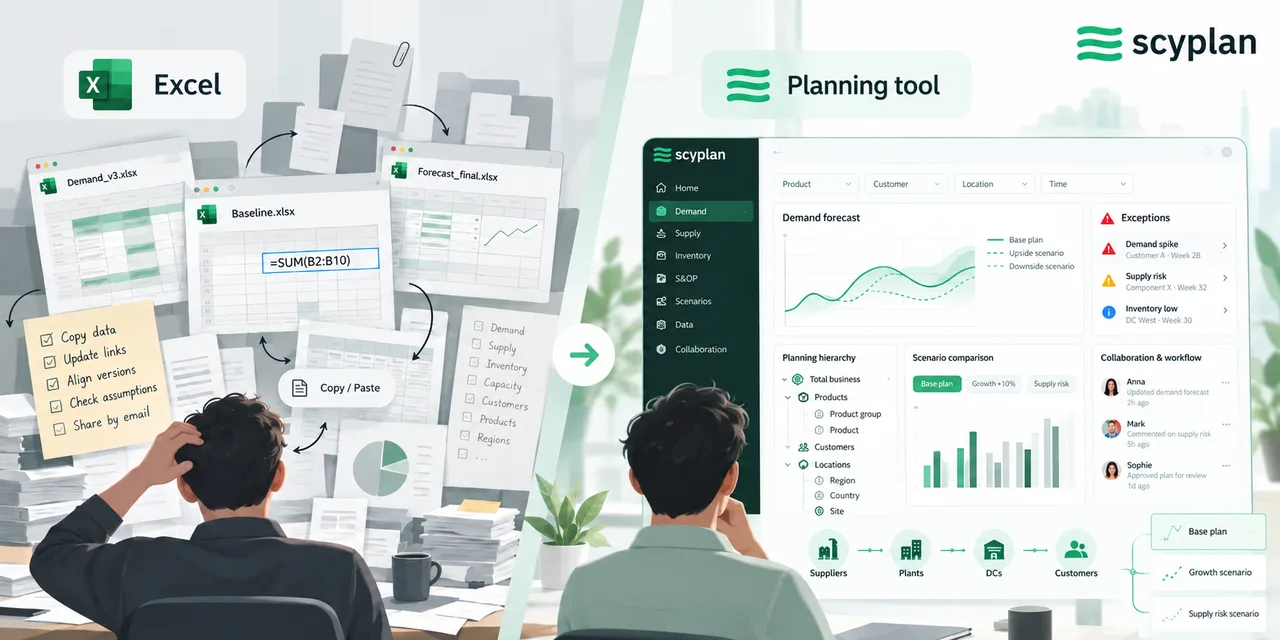
Excel vs Supply Chain Planning Software
Excel can support sophisticated supply chain planning. The real difference appears in everything around the forecast: data, workflow, collaboration, scenarios and control.
5 min read

The Worst Forecast Is Not Always Your Biggest Problem
The SKU with the worst forecast accuracy may not be your biggest planning problem. Better prioritization connects forecast exceptions with their business impact.
5 min read
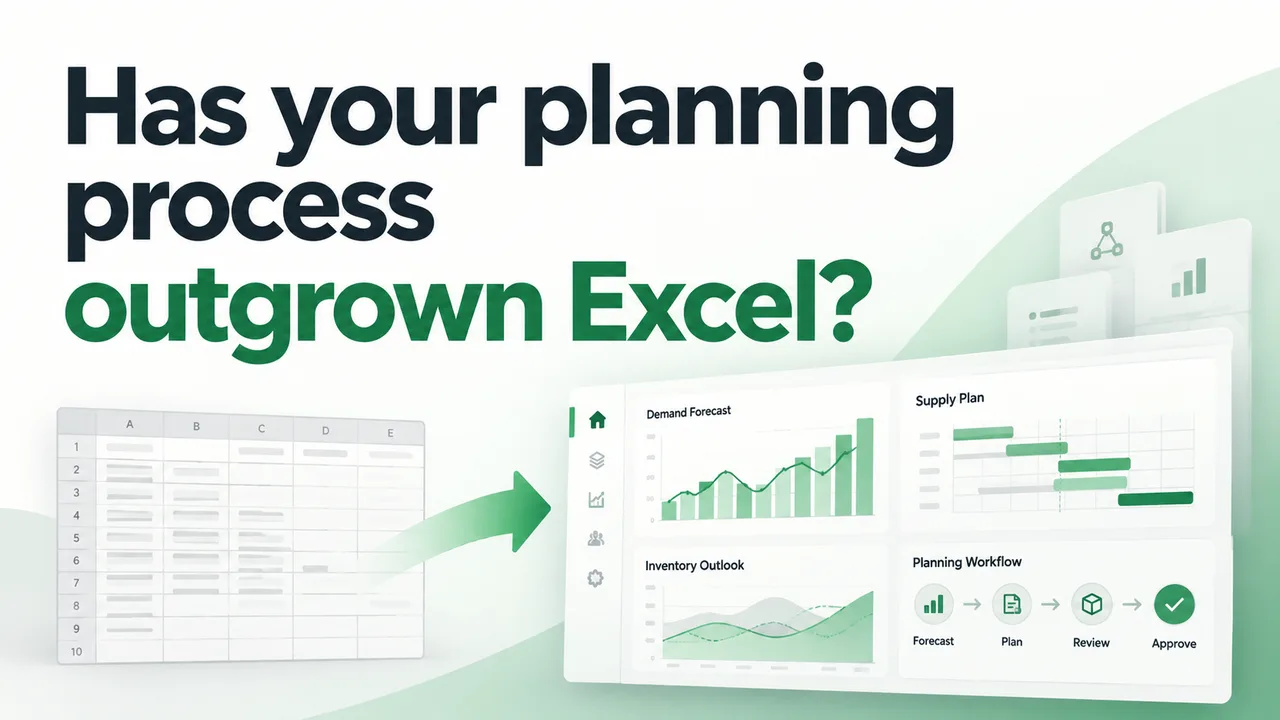
Is Your Planning Process Ready to Move Beyond Excel?
Excel is often a great place to start supply chain planning. It is flexible, familiar, and easy to build around. The question is: when has your planning process outgrown Excel?
2 min read