
Why Forecast Overrides Often Make Forecasts Worse
A demand planner reviews the statistical forecast and decides the number looks too low. Sales expects stronger demand, a customer may be preparing a promotion, or recent conversations suggest that…
3 min read
A demand planner reviews the statistical forecast and decides the number looks too low. Sales expects stronger demand, a customer may be preparing a promotion, or recent conversations suggest that the historical pattern no longer tells the full story. The planner increases the forecast, and the new number becomes part of the demand plan.
That is a normal part of demand planning. Statistical forecasts are built from the information available to the model, while planners often have context that has not yet appeared in the data. The question is therefore not whether planners should override forecasts, but whether those adjustments consistently make the forecast better.
Planner judgment is most valuable when it adds new information
There are many situations where an override makes sense. A planner may know that a large customer has confirmed a promotion, a product will soon be delisted, or an unusual order should not be treated as recurring demand. If that information is not available to the forecasting model, the planner is adding something genuinely new to the forecast.
The distinction becomes less clear when the adjustment is based primarily on judgment that a number seems too high or too low. Commercial optimism, pressure to meet a target, or discomfort with a statistical forecast can all influence the final number without necessarily adding better information.
Research suggests this distinction matters. A study covering more than 60,000 forecasts across four supply chain companies found that judgmental adjustments improved forecast accuracy on average in three of the four companies. However, smaller adjustments frequently reduced accuracy, while larger adjustments were more likely to improve it. Upward adjustments were also less successful than downward adjustments on average. Read the original study in the International Journal of Forecasting.
A more recent analysis covering approximately 147,000 forecasts found a similar pattern. Judgmental adjustments improved forecast performance for only slightly more than half of the SKUs studied, with considerable variation between datasets. In other words, human input can add value, but the act of changing the forecast is not evidence that value was added.
A simple question can improve forecast reviews
One practical way to make overrides more disciplined is to ask what information the adjustment introduces that was not already available to the forecasting model.
A confirmed customer promotion provides new information. So does a planned product discontinuation, a lost customer, a known one-off order, or another business event that has not yet appeared in the historical demand pattern. An adjustment based mainly on the belief that demand “should be higher” is much harder to evaluate.
This does not mean every override needs a lengthy approval process. It means the reason behind the change should be visible enough that the organization can later determine whether that type of intervention actually improved the forecast.
That becomes especially useful when the same behavior appears repeatedly. If planners consistently increase forecasts for a certain category and those changes create upward bias, the process may need to change. If overrides around customer promotions consistently improve accuracy, that suggests the planners have access to information that should perhaps become a more structured input to the forecasting process.
Measure whether the planning process adds value
The most useful way to settle the question is to measure the effect of the adjustment. Planning teams can compare the statistical forecast with the final forecast using the same horizon, level of aggregation and accuracy metric. This is the principle behind Forecast Value Added, or FVA: measuring whether each step in the forecasting process improves the forecast that entered that step.
The objective is not to reduce planner involvement. It is to understand where planner judgment performs well and where additional intervention creates noise. Over time, that allows the planning team to spend more attention on situations where human context genuinely matters while relying more confidently on the statistical forecast where manual changes have historically added little value.
It can also reveal opportunities to improve the forecasting model itself. If planners repeatedly make the same type of correction, the underlying issue may be a missing input rather than a need for permanent manual intervention.
Good demand planning therefore depends on both statistical forecasting and human judgment. The strongest process is one that understands where each source of information performs well, measures the result, and learns from the difference.
For Scyplan, that principle is important: planner adjustments should remain transparent and measurable so that teams can understand whether an intervention improved the forecast and why.
Planning, Simplified.
Other relevant articles
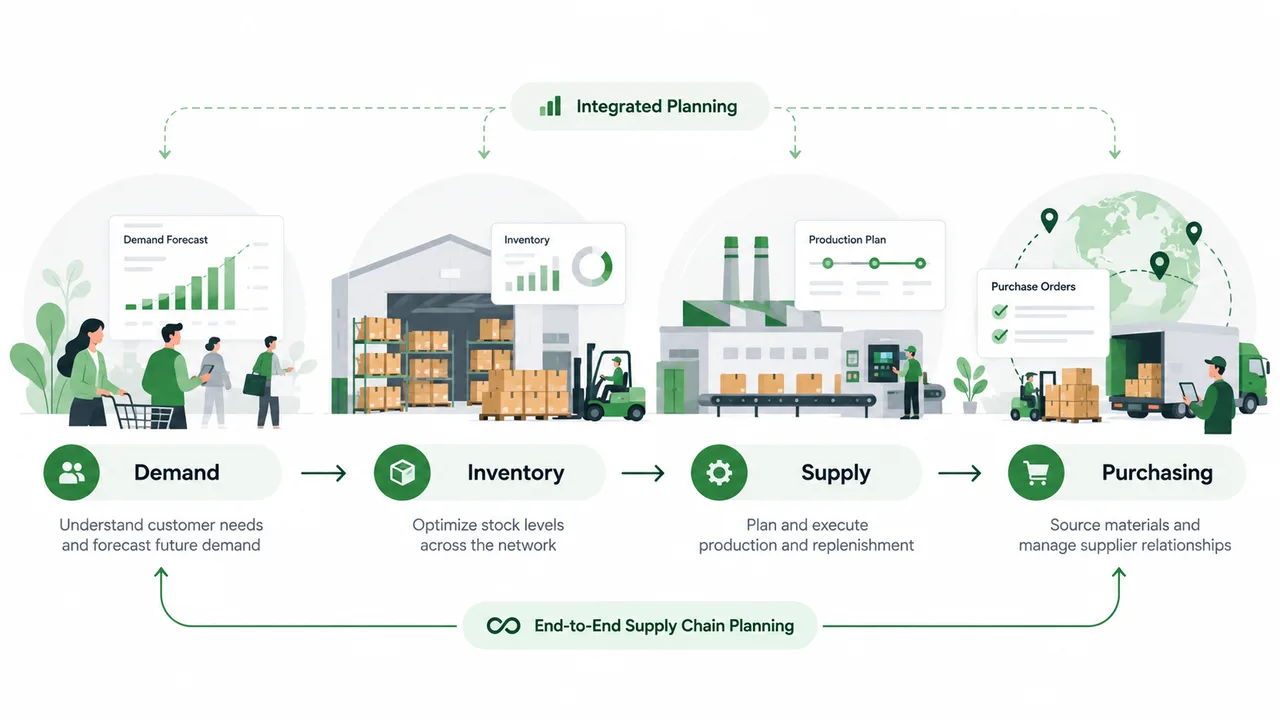
What Is an End-to-End Planner and How Do We Get There?
End-to-end planners connect decisions across demand, inventory, supply, production and procurement. Their rise also changes how we think about the traditional IBP cycle.
4 min read

Buy Planning Software or Vibe Code It in Excel?
AI makes it surprisingly easy to build planning tools in Excel. The harder question is whether your planning team wants to become responsible for maintaining them.
3 min read

Excel vs Supply Chain Planning Software
Excel can support sophisticated supply chain planning. The real difference appears in everything around the forecast: data, workflow, collaboration, scenarios and control.
5 min read