Why Mid-Market Companies Need Different Planning Software
For years, supply chain planning software has largely been developed with large enterprises in mind. That is understandable. Global companies often manage complex networks, thousands of SKUs,…
5 min read
For years, supply chain planning software has largely been developed with large enterprises in mind. That is understandable. Global companies often manage complex networks, thousands of SKUs, multiple business units, different regional processes, and large planning organizations. They need sophisticated systems capable of handling that complexity.
The challenge is that the same philosophy is often applied to mid-market companies, even though their reality is very different.
Too often, a mid-market business ends up buying what is essentially a scaled-down version of an enterprise planning platform. The system may be highly capable, but it often comes with the same underlying complexity: long implementation timelines, heavy configuration requirements, extensive training, significant consulting support, and functionality that many planners will never use.
For a large enterprise, that may be acceptable. For a mid-market company, it can quickly become a burden.
More capability does not always create more value
Enterprise software is typically designed to accommodate as many use cases as possible. From a product perspective, that makes sense. Different customers need different workflows, different planning methodologies, different hierarchies, and different levels of customization.
The downside is that this flexibility often becomes visible to the end user.
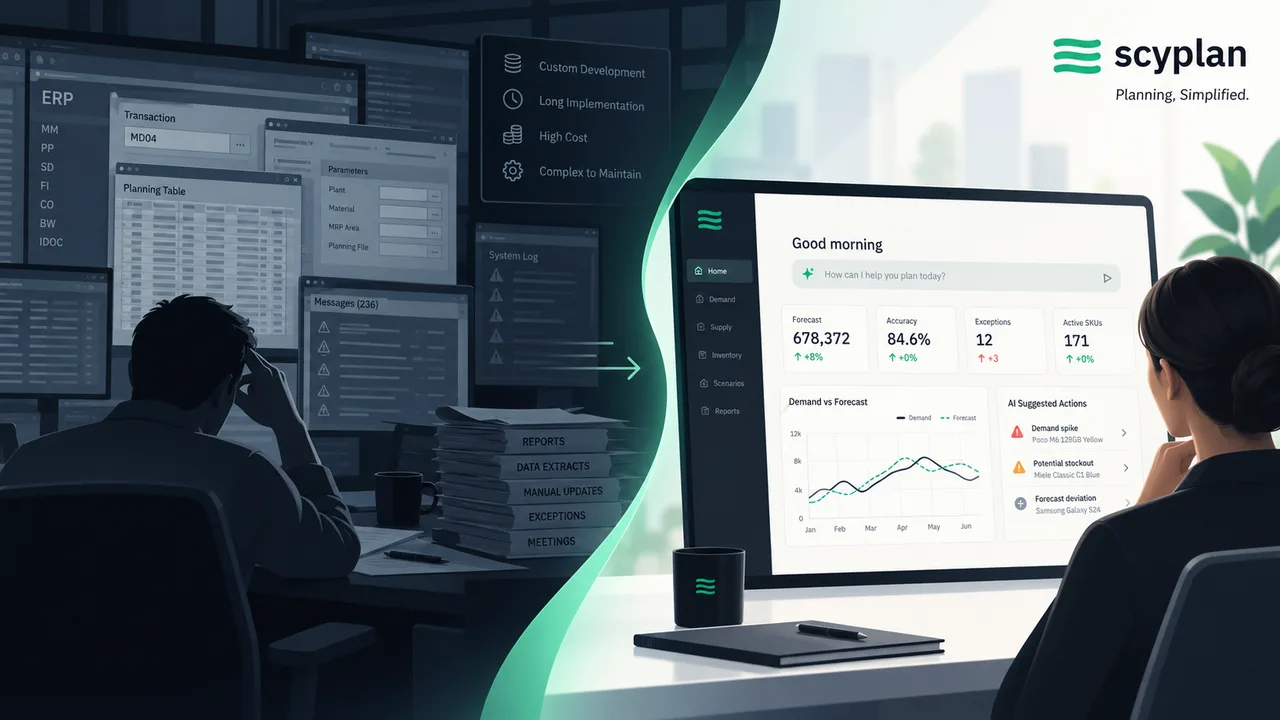
Planners may be confronted with large menus, complex settings, transaction IDs, configuration screens, and processes that require extensive training before they become second nature. Internally, we sometimes joke about “Chernobyl interfaces”: systems that look more like a control room than a modern business application.
That may sound harsh, but the underlying point is important. A planning system can be incredibly powerful while still being unnecessarily difficult to use.
In many organizations, planners ultimately use only a fraction of the available functionality. The rest remains in the system because it might be needed by someone, somewhere, at some point. Yet that unused complexity still has a cost. It makes implementation more difficult, increases training requirements, slows adoption, and creates dependency on experts who understand how the system is configured.
For mid-market companies, the question should therefore not be how much functionality a system has. The better question is how much value planners can actually access from it.
Implementation should not become a multi-year transformation
The same issue applies to implementation.
Large enterprises sometimes have the resources to support long transformation programs involving internal project teams, consulting firms, dedicated IT resources, process redesign, integration work, change management, and months of testing. These projects can be justified when the organization is large enough and the expected benefits are significant enough.
Most mid-market companies operate differently. Their planning teams are smaller, their IT resources are more limited, and people often have broader responsibilities. They cannot always afford to dedicate a large team to a planning transformation for a year or more before the software begins to deliver meaningful value.
This makes time to value much more important.
A mid-market planning solution should be designed with that constraint in mind. Integrations should be simpler, configuration should be more intuitive, and the system should be able to evolve as the company grows without every change becoming another implementation project.
The goal should not be to simplify the business until it fits the software. The software should be flexible enough to support the business without requiring unnecessary complexity around it.
Sophistication belongs in the backend
None of this means that mid-market companies need less sophisticated planning capabilities.
In fact, the opposite is increasingly true.
Advances in statistical forecasting, machine learning, optimization, and AI make it possible to perform analysis that would have required significant specialist resources only a few years ago. Mid-market companies should be able to benefit from those capabilities just as much as larger enterprises.
The important distinction is where that sophistication sits.
A planning system can have PhD-level sophistication in the backend without requiring PhD-level knowledge from the person using it. The mathematical models, algorithms, anomaly detection, forecasting methods, and optimization logic can all be advanced while the user experience remains simple and intuitive.
The planner should not need to understand every method being used behind the scenes. What matters is whether the system can help answer practical questions such as: What changed? Which products require attention? Where is forecast bias increasing? Why did performance deteriorate? What should I look at next?
The technical capability already exists to answer many of these questions. The challenge is making that capability accessible to the planner.
AI can change how planners interact with software
This is where AI becomes particularly interesting.
Traditional planning systems have largely been built around the idea that the system provides information and the planner performs the analysis. A planner opens a dashboard, identifies an exception, moves into another screen, investigates historical data, compares forecasts, looks for possible drivers, and eventually decides whether action is required.
That workflow puts a large analytical burden on the planner.
AI creates an opportunity to reverse part of that relationship. Instead of asking planners to continuously search the system for issues, the system can increasingly perform that analysis in the background and bring the most relevant exceptions to the planner.
It can identify unusual behavior, prioritize issues by business impact, investigate likely causes, summarize changes, and suggest where further attention is needed. The planner can then focus on the part where human judgment adds the most value: understanding context, challenging assumptions, collaborating with the business, and making decisions.
This does not mean replacing planners. It means changing how their time is spent.
A planner should not have to spend the first half of the day finding out what went wrong before being able to think about what to do about it.
From analysis-driven to action-driven planning
For me, this is one of the most important changes planning software needs to make.
Many systems are still designed around providing more information. More dashboards, more reports, more metrics, and more ways to slice the data. While those capabilities are useful, they do not necessarily make the planning process better.
The real objective should be to help planners move from information to action more quickly.
That means identifying what matters, explaining why it matters, and making it easier to decide what happens next. It also means recognizing that the planner does not need to investigate every SKU, every forecast, or every exception. The system should help prioritize attention where it will have the greatest impact.
This is especially relevant in the mid-market, where planning teams are often lean. A smaller team cannot spend hours every week navigating through thousands of data points to identify the handful of issues that genuinely require intervention.
Planning software should do more of that work for them.
The mid-market needs a different design philosophy
Mid-market companies should not have to choose between spreadsheets on one side and highly complex enterprise platforms on the other.
There is room for a different generation of planning software: software that is sophisticated enough to handle complex supply chain problems but designed around the realities of smaller planning organizations. That means faster implementation, lower complexity, more intuitive workflows, easier access to advanced capabilities, and a greater focus on action.
The future of planning software is not about making planning less sophisticated. It is about making sophisticated planning easier to use.
That is the philosophy behind Scyplan.
Planning, Simplified.
Other relevant articles
Excel vs Supply Chain Planning Software
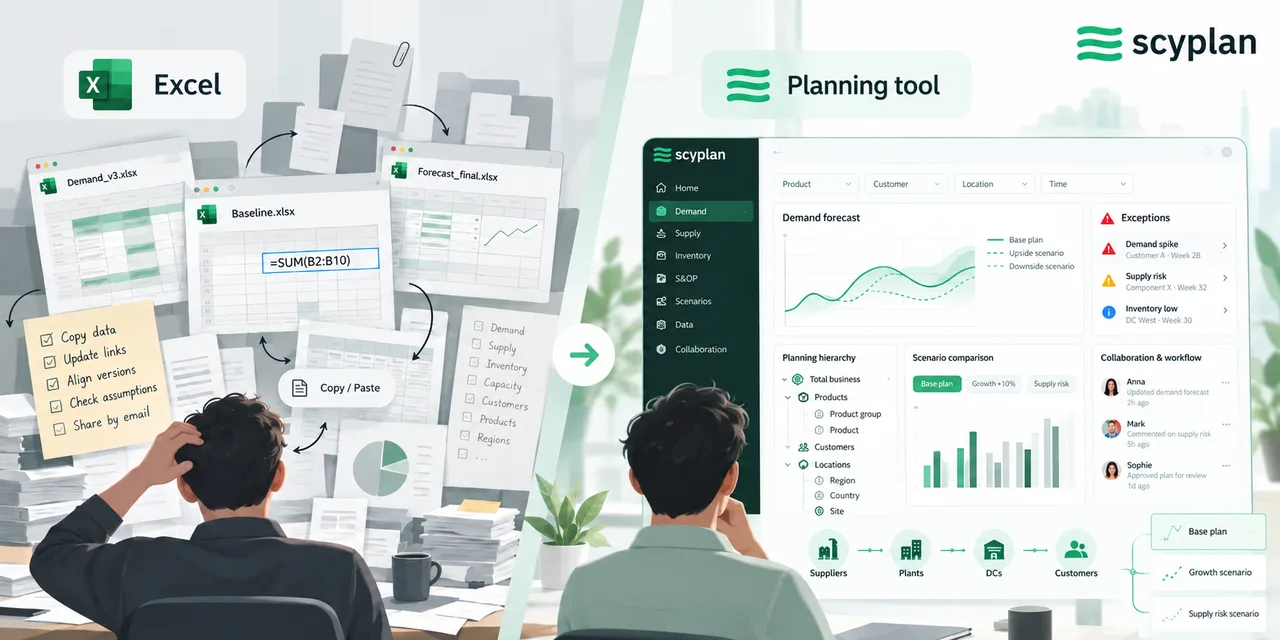
Excel can support sophisticated supply chain planning. The real difference appears in everything around the forecast: data, workflow, collaboration, scenarios and control.
5 min read

The Worst Forecast Is Not Always Your Biggest Problem
The SKU with the worst forecast accuracy may not be your biggest planning problem. Better prioritization connects forecast exceptions with their business impact.
5 min read
How the Supply Chain Planner Role Is Changing
The planner’s role is shifting from processing information toward managing exceptions, trade-offs, and decisions. What skills and KPIs matter as planning technology improves?
4 min read